Most BAMS graduates, at some point after completing their degree, find themselves asking a simple question: what next? Some go for MD in Ayurveda. Some take up general practice. And a growing number are choosing to build a focused career in dermatology — not through an MD Skin, which is a different route entirely, but through practical, clinical training in Ayurvedic dermatology and cosmetology.
If you have been wondering whether you can practice as a skin specialist after BAMS, this guide is for you. It walks through the real options available, what each one covers, and how to decide which path actually fits your situation.
Can a BAMS Doctor Become a Skin Specialist?
Yes — and many already have. BAMS graduates have a foundational understanding of skin through their training in Twak Chikitsa, Kushtha Roga, and related subjects. Ayurveda classifies and approaches skin disorders in a way that modern cosmetology does not. That background is genuinely useful.
What BAMS training does not give you, however, is hands-on exposure to modern dermatology procedures — chemical peels, laser treatments, PRP therapy, or managing acne scars with procedural techniques. That is the gap that skin specialist courses after BAMS address.
It is worth being clear about something: these are clinical training programs, not MD Dermatology. They do not replace a postgraduate medical qualification. What they do is give BAMS doctors structured, practical training so you can work confidently in a skin and cosmetology setup.
Why Many AYUSH Doctors Choose Dermatology
Skin-related complaints are among the most common reasons patients visit any clinic — urban or rural, private or otherwise. Acne, pigmentation, hair fall, warts, skin tags — these show up in practice constantly, regardless of your specialty.
For BAMS doctors, this creates a real opening. Patients are already coming to Ayurvedic clinics with skin concerns. If you have the clinical skills to address those concerns properly, you become significantly more useful to your patients and more productive as a practitioner.
Dermatology also offers a relatively straightforward path to setting up a focused practice. Compared to many other medical specialties, a basic skin clinic does not require massive infrastructure. For BAMS doctors who want an independent clinical setup without years of postgraduate study first, this makes it one of the more practical directions.
Understanding Different Learning Options After BAMS
Not all courses after BAMS are the same. Before deciding, it helps to understand what the main formats actually offer.
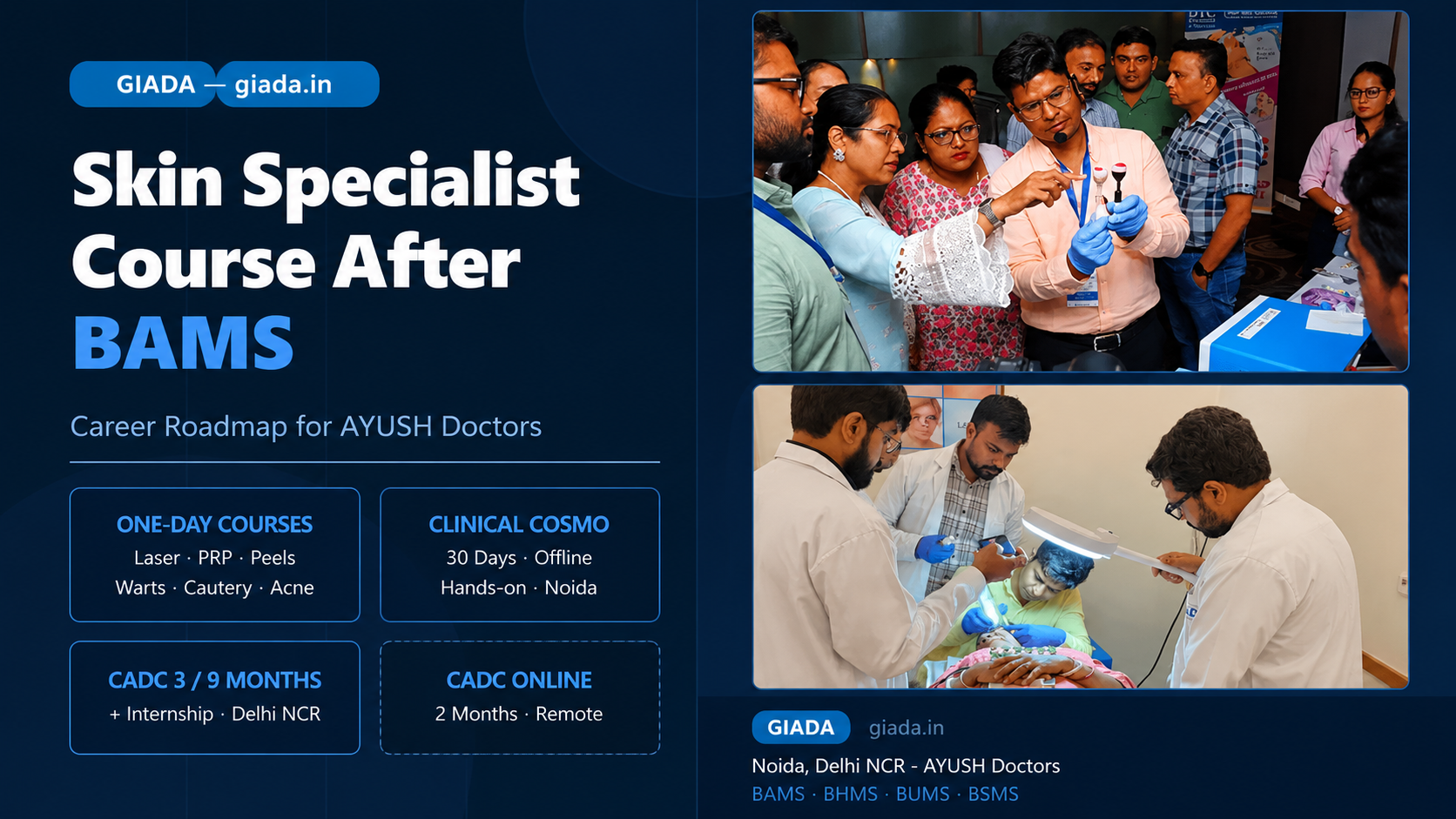
- ➜ One-day workshop programs focus on a single procedure — you come in, learn it hands-on, and leave with both a certificate and basic working knowledge of that technique. These are best for doctors already in practice who want to add a specific skill.
- ➜ Short certificate courses (two to three months) cover a broader curriculum — skin conditions, cosmetic procedures, treatment protocols, patient management — alongside hands-on clinical work.
- ➜ Longer fellowship-format programs (six to nine months) go deeper. They typically include an internship component where you actually work in a clinical setting, handling patients under supervision over an extended period.
- ➜ Online courses cover theory — skin anatomy, common conditions, treatment frameworks — without the hands-on component. These work for doctors who want to build foundational knowledge but cannot leave their current practice.
One-Day Certificate Courses in Dermatology
For practicing doctors who want to add a specific procedure to their clinic, one-day certificate courses are a practical starting point. These are focused, hands-on programs — not lectures — where you learn a procedure by doing it.
GIADA offers the following one-day certificate programs for AYUSH doctors:
- ➜ Doctors looking to manage one of the most common skin complaints in Indian clinics can start with the Acne & Acne Scar Management course, which covers both medical management and procedural treatment of acne and its aftermath.
- ➜ For doctors who want to add laser-based treatments to their practice, the Certificate in Laser Procedures provides hands-on training in laser use across different skin indications.
- ➜ Chemical peeling is one of the most commonly requested cosmetic procedures in Indian skin clinics. The Hands-On Certificate in Chemical Peeling covers patient selection, peel selection, application technique, and post-procedure care.
- ➜ PRP (Platelet Rich Plasma) therapy is used extensively for both hair and skin concerns. The Hands-On Certificate in PRP Management teaches the different PRP preparation techniques and their applications.
- ➜ Warts are a frequent presentation in general practice and skin clinics both. The Certificate in Warts Management covers diagnosis and procedural removal techniques.
- ➜ Electric cauterization is used for a range of minor skin lesions. The Certificate in Electric Cauterization trains doctors in safe use of cautery for common indications.
Each of these is suitable for BAMS and BHMS doctors. They are not theoretical workshops — the emphasis is on doing the procedure, not just watching.
Certificate in Clinical Cosmetology & Aesthetic Medicine
One-day courses teach individual procedures well. But some doctors want something more comprehensive — not just one skill, but a working knowledge of clinical cosmetology as a whole — without committing to a three-month full-time program.
That is where the Certificate in Clinical Cosmetology & Aesthetic Medicine fits in. It is a 30-day offline, hands-on training program conducted at Noida, open to BAMS, BHMS, BUMS, and BSMS doctors.
The course covers ten structured modules — starting from skin anatomy, Fitzpatrick typing, and clinical consultation, moving through chemical peels, microneedling, PRP and GFC, laser science and applications, trichology, acne and pigmentation management, and going all the way up to clinic setup, Instagram and Google marketing, and practice growth strategies. Advanced procedures like Botox and fillers are covered for academic awareness and patient counselling purposes, not as hands-on components.
What makes this course practically useful is its breadth. In 30 days, you get a working overview of most of what a functional cosmetology clinic does — patient assessment, procedure selection, clinical safety, documentation, and even how to manage complications when they arise. It is structured for doctors with no prior cosmetology experience, and equally useful for those already in practice who want to consolidate and organise what they know.
For BAMS graduates who want a solid cosmetology grounding before deciding on a longer commitment like CADC, or for practicing doctors who cannot take 90 days off but can manage a month, this is a practical middle-ground option.
CADC Course: A Structured Learning Pathway
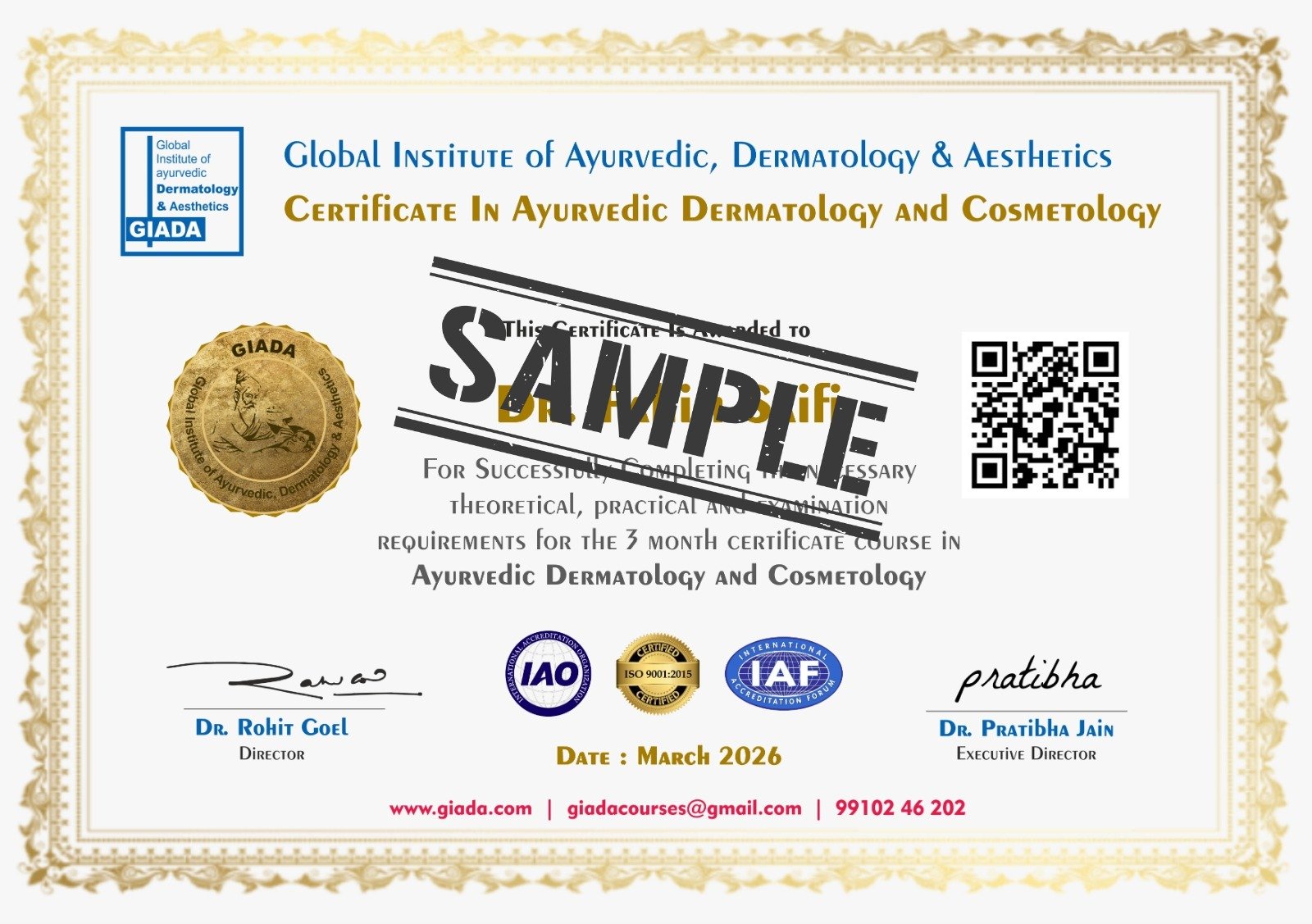
If one-day courses are about adding a skill, the CADC — Certificate in Ayurvedic Dermatology and Cosmetology — is about building a career direction. It is GIADA's main dermatology training program for AYUSH doctors, and it comes in three formats depending on your situation.
CADC 3-Month Module
This is a full-time, in-person program covering dermatology fundamentals, cosmetology procedures, patient counselling, differential diagnosis, treatment planning, and clinic management basics. Classroom learning runs alongside actual patient exposure at GIADA's clinical centres in Delhi NCR.
The 3-Month CADC suits recent BAMS graduates who want to build a strong clinical foundation before starting practice, and also for practicing doctors who can take three months out for focused training.
CADC 9-Month Module
This is the more comprehensive version. The first three months follow the same curriculum as the standard CADC. The remaining six months are a structured internship — you work in a clinical setting, assist in procedures, handle patient cases, and build the kind of confidence that comes from sustained, supervised practice.
The 9-Month CADC with Internship is the right choice if you are serious about dermatology as your long-term clinical direction. The internship phase is where most of the real skill development happens. Knowing how to do a procedure and being comfortable doing it on a new patient, without hand-holding, are two different things. The internship bridges that gap.
CADC Online Dermatology Course
For doctors who cannot relocate or step away from their practice for months at a time, GIADA offers a two-month CADC Online Dermatology Course. It covers the full theoretical curriculum — skin anatomy, common skin conditions, Ayurvedic treatment approaches, cosmetic formulations, and case-based learning.
What it does not include is hands-on procedure training. If you complete the online course and then want procedural training, you can follow it up with one-day certificate workshops. Many doctors use this combination: online course for the knowledge base, one-day workshops for specific procedures.
How to Choose the Right Course
This comes down to a few practical questions.
- ➜ Are you a fresh BAMS graduate trying to figure out your direction? The 3-month CADC gives you enough clinical exposure to know whether dermatology is genuinely for you, and enough training to begin practice with some confidence.
- ➜ Are you already in practice but want to add skin and cosmetology services? One-day certificate courses let you add specific procedures without disrupting your current setup. If you want a broader cosmetology foundation in a short, intensive format, the 30-day Clinical Cosmetology course is a practical middle ground before stepping into a longer program like CADC.
- ➜ Do you want to set up a full-time skin clinic? Then the 9-month CADC with internship makes the most sense. The clinical hours and patient exposure you get during the internship are genuinely difficult to replicate any other way.
- ➜ Cannot leave your city or take extended leave? The online CADC is designed exactly for that situation. Pair it with one-day certificate workshops to build the procedural side.
Common Questions AYUSH Doctors Ask
- ➜ Is a dermatology certificate enough to start a skin clinic? It depends on what you mean by "enough." A structured course like CADC gives you the clinical foundation. What you also need is actual practice experience — which is why the internship module exists.
- ➜ Do I need to know English well for these courses? GIADA's courses are conducted in Hindi, which makes them accessible for most doctors who trained at Hindi-medium Ayurvedic colleges.
- ➜ What is the difference between CADC and a fellowship course in dermatology? Functionally, the 9-month CADC with internship serves the same purpose as what many institutes call a "fellowship" — extended, structured clinical training beyond a basic certificate.
- ➜ Will I be able to use lasers and modern equipment after CADC? Yes. Practical training in laser procedures, PRP, chemical peeling, and electric cauterization is part of the curriculum.
Conclusion
The career path after BAMS in dermatology is more accessible than many doctors assume. You do not need to go back for an MD or wait years before starting a skin practice. What you need is structured, hands-on clinical training — which is exactly what these courses after BAMS are designed to provide.
Start with whatever format matches your current situation. One-day certificate courses if you are already in practice and want to add procedures. The CADC if you want a systematic foundation. The 9-month module if you are serious about dermatology as your primary clinical direction.
The Ayurvedic background you already have is an asset in this field, not a disadvantage. You understand skin from the inside out — Twak, Rakta, Pitta, the role of dietary and lifestyle factors. Combine that with practical procedural training, and you have something that most skin clinics genuinely value.